Is your office drowning in filing cabinets? Are your employees spending more time typing data than analyzing it? While paper forms served their purpose for decades, there comes a time when they actively hold your business back.
In today’s fast-paced digital economy, sticking to manual, paper-based processes is no longer just a minor inconvenience, it’s a competitive disadvantage.
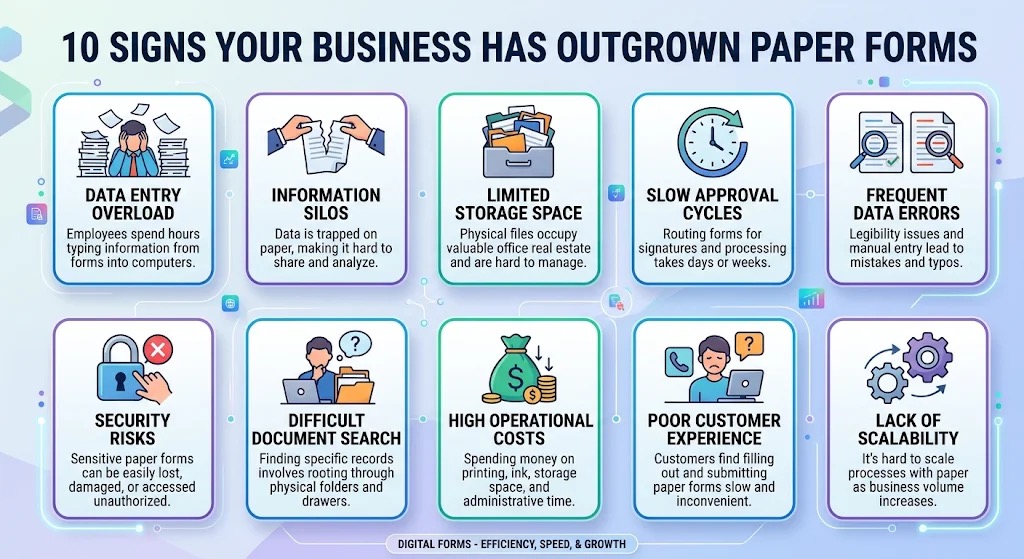
If you are experiencing any of the following 10 red flags, it is time to embrace digital forms for better efficiency, speed,and growth.
1. Data Entry Overload
Are your highly skilled employees spending valuable hours manually typing information from physical forms into computers? This is a massive drain on productivity. Digital forms capture data instantly at the source, eliminating redundant tasks.
2. Information Silos
Data trapped on paper is invisible data. If different departments cannot easily share and analyze information because it resides in a physical file somewhere, your collaborative intelligence is suffering.
3. Limited Storage Space
Physical files occupy valuable office real estate that could be used for revenue-generating activities. Furthermore,managing the logistics of archiving and retrieving years of physical paperwork is a headache you don’t need.
4. Slow Approval Cycles
Does routing a form for simple signatures or processing take days or even weeks? Paper bottlenecks crush your business agility. Digital workflows move at the speed of the internet, not the speed of an interoffice mail envelope.
5. Frequent Data Errors
Legibility issues, coffee stains, and manual data entry naturally lead to mistakes. Digital forms utilize data validation rules, dropdowns, and clear fonts to ensure you capture accurate information the first time.
6. Security Risks
Paper is fundamentally insecure. Sensitive forms can be easily lost, damaged by disasters, or accessed by unauthorized individuals. Digital systems offer robust access controls, encryption, and secure cloud backups.
7. Difficult Document Search
When you need a specific record from three years ago, does it involve rooting through dusty folders and filing drawers?In a digital environment, finding that same document takes a few keystrokes and seconds.
8. High Operational Costs
The cost of the paper itself is just the tip of the iceberg. When you factor in printing, ink, storage space, and the sheer amount of administrative time spent managing paper, the operational costs are staggering.
9. Poor Customer Experience
In the age of instant gratification, customers find filling out and submitting paper forms slow and inconvenient.Transitioning to sleek digital forms shows you value their time and modernizes your brand image.
10. Lack of Scalability
You cannot scale a physical stack of paper efficiently. As your business volume increases, paper processes become exponentially harder to manage. Digital systems are built to grow with you effortlessly.
The Conclusion
If you recognized your business in this list, don’t worry—there is a clear path forward. Transitioning to digital forms doesn’t just solve these 10 problems; it unlocks new levels of efficiency, data insights, and growth.
Stop pushing paper and start scaling your business.
Related Article: Why Offline Forms Matter When Your Business Works in the Field https://blog.formconnections.com/why-offline-forms-matter-when-your-business-works-in-the-field/