In an era of hyper-connectivity, high-speed 5G, and ubiquitous Wi-Fi, it’s easy to assume that the internet is everywhere. But if your business relies on a mobile workforce—whether field technicians, construction crews, utility inspectors, or agricultural surveyors—you know the reality is starkly different.
The moment your team steps into a basement, a remote rural job site, a heavily insulated industrial plant, or encounters a sudden network outage, connectivity vanishes. When your digital tools require a live internet connection to function, work grinds to a halt.
This is where offline forms become a game-changer. Here is why investing in offline-capable data collection is essential for businesses operating in the field.
1. Zero Downtime, Maximum Productivity
When field workers can’t submit reports, checklists, or work orders due to poor signal, they are forced to wait. They might pace the job site, try repeatedly to send a file, or worse, resort to paper forms that will need to be manually re-entered later.
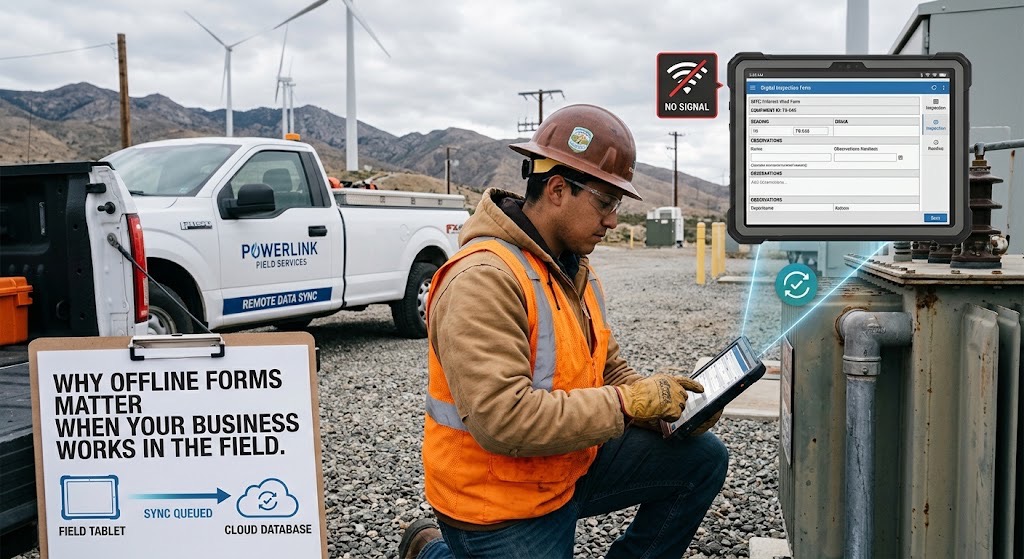
Offline forms allow your team to capture data seamlessly, regardless of network availability. The form data is stored securely on the mobile device’s local storage and automatically syncs to your central database the moment a connection is re-established. Your field staff spends their time doing actual work—not fighting with connection drops.
2. Elimination of Dual-Data Entry and Lost Paperwork
Before digital transformation, the backup plan for dead zones was always paper. Field workers would clip paper inspection sheets to a clipboard, fill them out with a pen, and drop them off at the office at the end of the week.
This traditional workflow introduces massive inefficiencies:
-
Illegible handwriting: Misreading numbers or notes leads to costly mistakes.
-
Lost or damaged paperwork: Rain, mud, or a misplaced clipboard means the data is gone forever.
-
Double handling: Administrative staff have to spend hours re-typing handwritten notes into digital systems.
Offline digital forms bridge the gap. They give workers the speed and reliability of paper combined with the accuracy and structure of digital databases—without needing a live signal.
3. Uncompromising Data Accuracy and Validation
Paper forms don’t care if you miss a required field, miscalculate a total, or enter a date in the wrong format. Digital offline forms, however, can run built-in validation rules locally on the device.
Even without an internet connection, an offline form can:
-
Enforce mandatory fields so technicians can’t submit incomplete work orders.
-
Perform automatic calculations (e.g., multiplying hours by rate or summing inventory parts).
-
Restrict input types (ensuring numbers are entered where numbers are required).
This ensures that the data being collected is clean, structured, and accurate right at the source.
4. Enhanced Safety and Compliance
In industries like construction, oil and gas, and utilities, regulatory compliance and safety checklists are non-negotiable. If an inspector or technician is on-site at a remote facility and cannot access or submit a safety audit because of no cell service, they face an impossible choice: delay the project or proceed without documenting compliance.
Offline forms ensure that critical safety checklists, hazard assessments, and equipment logs are completed and time-stamped right when they happen. Even if the upload happens hours later, the immutable digital trail proves that safety protocols were followed on schedule.
5. Better Customer Experience and Faster Turnaround
When your field team works efficiently, your customers reap the benefits. Whether it’s a routine HVAC repair, a home inspection, or an emergency utility fix, customers expect rapid turnaround times on service reports, invoices, and completion certificates.
If your technicians have to wait until they return to the office—or until they drive back into cell range—to file their paperwork, billing and customer communication are delayed. Offline forms allow field workers to capture customer signatures on-site and queue up automated emails or invoices to send the second connection is restored. Faster reporting translates directly to faster invoicing and happier clients.
Conclusion
Relying entirely on cloud-connected tools in the field is a hidden bottleneck for many modern businesses. Dead zones are an inevitable part of field operations, but they don’t have to mean lost productivity and delayed data.
By implementing robust offline forms, you ensure that your workforce remains agile, your data stays accurate, and your business operations run smoothly—come rain, shine, or zero bars.
FormConnections (https://www.formconnections.com) provides digital form solutions for individuals, power users, and teams.