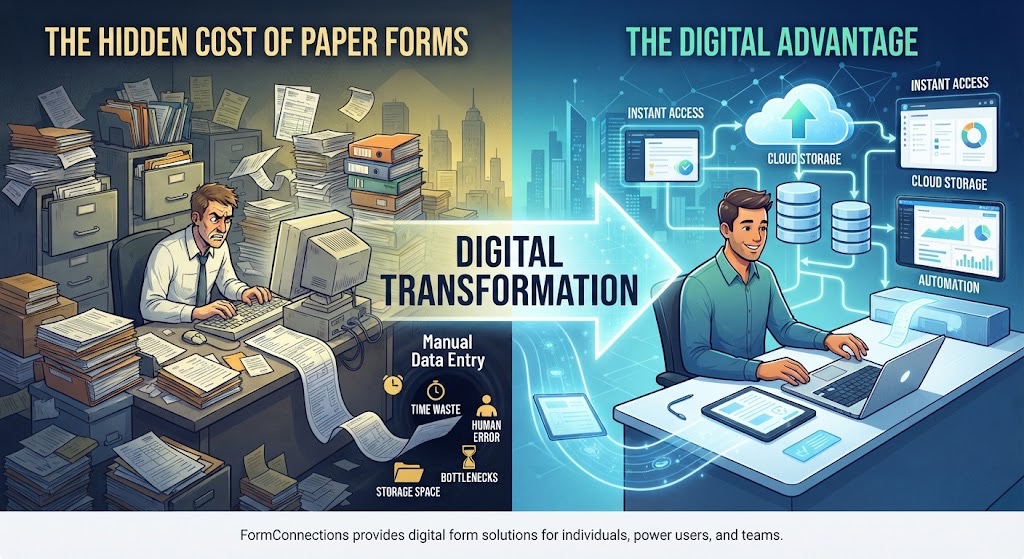
In an era where remote collaboration, instant communication, and automated workflows rule the business world, it is surprising how many organizations still rely on paper forms. From onboarding new hires and collecting customer feedback to processing expense reports and field service logs, clipboard-and-pen routines remain deeply ingrained.
At a glance, paper feels harmless—familiar, tactile, and requiring zero technical setup. However, beneath the surface lies a web of hidden expenses that drain productivity, bloat operational budgets, and introduce costly errors.
Let’s break down the true hidden costs of manual data entry and why making the switch to digital forms is no longer just a modernization choice—it’s a competitive necessity.
1. The Labor Trap of Manual Data Entry
When a customer, employee, or partner fills out a paper form, the journey of that data has barely begun. Someone must physically collect the paper, decipher handwritten notes (which often leads to guesswork), and manually type that information into a spreadsheet, CRM, or database.
-
Wasted Hours: Administrative staff spend countless hours performing repetitive data entry rather than focusing on high-value, revenue-generating tasks.
-
Labor Costs: Every minute spent transposing numbers and names from paper to a digital screen directly translates to payroll dollars wasted on administrative friction.
2. The Price of Human Error
To err is human, but manual data entry multiplies that risk exponentially. Typos in email addresses, transposed digits in phone numbers, or misread project codes can derail an entire operation.
-
Downstream Discrepancies: A single keystroke error in an order form can lead to shipping the wrong product, resulting in return shipping fees, delayed fulfillment, and frustrated customers.
-
Costly Corrections: Fixing data entry mistakes takes time and resources. Tracking down the source of an error disrupts workflows and damages professional credibility.
3. Storage, Logistics, and Material Overheads
Paper has physical weight and a continuous carrying cost.
-
Supplies: You are constantly paying for paper, printer toner, folders, binders, and physical storage cabinets.
-
Space and Security: Physical filing cabinets take up expensive square footage in offices. Furthermore, paper files are vulnerable to catastrophic loss from office fires, water damage, or misplacement, and they lack granular access controls to protect sensitive personal or financial information.
4. Delayed Turnaround Times and Lost Opportunities
Speed is everything in modern business. If a field technician fills out a service report on paper, that report is trapped in their truck until they return to the office at the end of the week.
-
Bottlenecks: Invoices can’t be sent, approvals can’t be signed, and client requests sit idle.
-
The Digital Advantage: Digital forms allow data to be captured, validated, and routed instantly to the right person or system the second the “Submit” button is pressed. Real-time visibility means faster decision-making and happier clients.
Embracing the Digital Transformation
Moving away from paper isn’t just about “going green”—it is about unlocking efficiency, reducing risk, and setting your team up to scale. Digital forms introduce automated validation (ensuring required fields are filled correctly before submission), cloud storage integration, and seamless analytics that turn raw data into actionable insights instantly.
FormConnections (https://www.formconnections.com) provides digital form solutions for individuals, power users, and teams.